Search Results for "中国体育彩票开奖直播-【✔️推荐AC68·CC✔️】-水果机 网页版-中国体育彩票开奖直播55ey7-【✔️推荐AC68·CC✔️】-水果机 网页版61x6-中国体育彩票开奖直播ygiog-水果机 网页版0c2q"
Showing results for cossack csáki casey cossack csáki ch8032 cossack casey cossack csaki csaki ch’io ch’io

Robert Fürstenthal: Complete Choral Music, Volume One
Like many Austrian Jews, Robert Fürstenthal (1920–2016) fled to the USA after the German invasion of his country in 1938. Music then became a link to his homeland: ‘When I compose, I am back in Vienna’. As an amateur composer, Fürstenthal preferred to work on a small scale, and his output of songs and chamber music is considerable. But he also wrote two sizable works for chamber choir, the first of which, in this series of two albums, is bookended by piano sonatas – all three works revealing that the tradition of Schubert and Brahms was alive in the California sun.
Ian Buckle, piano (Tracks 1–4, 16)
Richard Casey, piano (Tracks 5–10, 12–16)
Philippa Hyde, soprano (Tracks 6, 8, 12, 14)
Emma Roberts, contralto (Tracks 6, 7. 9, 12–15)
Rory Carver, tenor (Tracks 5–7, 10, 12, 14, 15)
Felix Kemp, bass (Tracks 5–7, 14)
Borealis (Tracks 5, 6, 8, 10, 13–15)
Skipton Camerata (Tracks 5–8, 10–15)
Stephen Muir, conductor (Tracks 5–15)
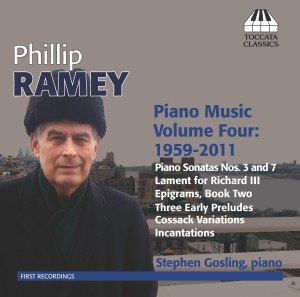
Phillip Ramey: Piano Music, Volume Four: 1959-2011
The piano music of the American composer Phillip Ramey (born in 1939) is rooted in the motoric athleticism of Prokofiev and Bartók, tempered with sober lyricism, spicy modernist dissonance and a fresh approach to the grand Romantic gesture. This fourth Toccata Classics album includes the virtuosic Cossack Variations, the mercurial Epigrams, Book Two and Lament for Richard III, a dramatic character-study of a famous historical villain. Two sonatas add further substance to a varied programme: No. 3, serially inflected and culminating in a barbaric finale; and No. 7, infused with declamatory rhetoric, quirky rhythm and engaging melody.
Stephen Gosling, piano
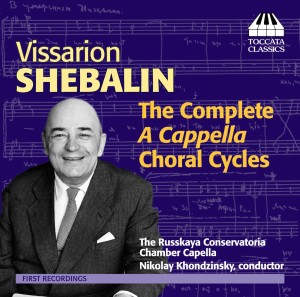
Vissarion Shebalin: The Complete A Cappella Choral Cycles
The Siberian-born Vissarion Shebalin (1902-63) is best known for his instrumental music, which includes five symphonies and nine string quartets, some of which have been heard on CD, but this is the first recording of the eight delightful, and very Russian, choral cycles he wrote from 1949. Shebalin had to endure much hardship: along with Shostakovich, a close friend and colleague, he was one of the composers condemned in the infamous 1948 Party congress in Moscow; and in later life he fought to overcome a series of crippling strokes. These tribulations he faced with understated but unshakable optimism, as these touching choruses reveal.
Russkaya Conservatoria Chamber Capella, choir
Nikolay Khondzinsky, conductor
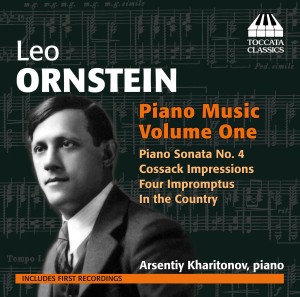
Leo Ornstein: Piano Music, Volume One
The Russian-born American composer Leo Ornstein (1893-2002) lived long enough — an astonishing 109 years — to see his music both fall into and re-emerge from obscurity. His earliest surviving work dates from around 1905; his last was composed in 1990. Not surprisingly, his music embraces a range of styles, ranging on this first CD — in the first extended series devoted to his piano works — from the atmospheric impressionism of the Four Impromptus via the fiery virtuosity of the Fourth Piano Sonata to the Rachmaninov-like Romanticism of the Cossack Impressions and In the Country.
Arsentiy Kharitonov, piano
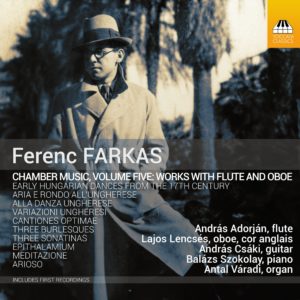
Ferenc Farkas: Chamber Music, Volume Five – Works for Flute and Oboe
This twelfth release in the Toccata Classics exploration of the music of Ferenc Farkas (1905–2000) once again puts his chamber music with flute in the spotlight – here with an oboe chaser. As with previous albums in this series, the music highlights the characteristics that make Farkas’ music so appealing: catchy tunes, transparent textures, buoyant rhythms, a fondness for Baroque forms and a taste for the folk-music of his native Hungary that marks him out as a true successor to Bartók and Kodály. The works in this recording are almost all reworkings – by Farkas or the two soloists here – of music first written for different forces and now taking on a new lease of life.
András Adorján, flute (Tracks 1–15)
Lajos Lencsés, oboe (Tracks 15, 19–22), oboe d’amore (Tracks 23–26), cor anglais (Track 27)
András Csáki, guitar (Track 12)
Balázs Szokolay, piano (Tracks 1–11, 13–21)
Antal Váradi, organ (Tracks 22–27)
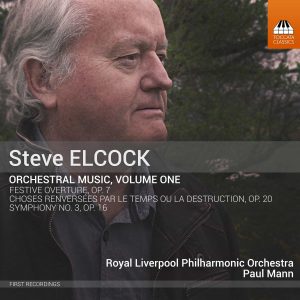
Steve Elcock: Orchestral Music, Volume One
The English composer Steve Elcock (b. 1957) has been writing music since his teens, but with virtually no contacts in the musical world, told no one what he was doing – and thus has evolved a compelling symphonic style entirely his own, combining virtuoso orchestral writing with a sense of momentum that has its roots in the Nordic-British tradition of Sibelius, Nielsen, Simpson, Brian and similar figures. His Third Symphony is a vast canvas generating fierce energy and titanic violence, leavened at times by a sardonic sense of humour. Choses renversées par le temps ou la destruction is a dark symphonic triptych where fragile beauty is constantly at threat from the forces of ignorance. The breezy, buoyant Festive Overture, by contrast, has a Waltonian swagger that barrels on with relentless good humour.
Royal Liverpool Philharmonic Orchestra
Paul Mann, conductor
James Clark, leader
Richard Casey, harpsichord Tracks 4, 6
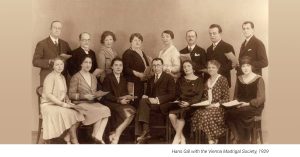
Songs of Love, Sorrow and Satire (And Not Forgetting the Baboon!): Recording Hans Gál’s Music for Voices
One of the proudest, happiest and most surreal moments in my singing career to date has been uttering the final notes of a choral concert…
Ottorino Respighi: L’Opera Per Pianoforte Solo
di Potito Pedarra Scrive Lorenzo Arruga presentando alcune “liriche più famose [di Respighi]: una volta le ho persino accompagnate in un piccolo concerto, accettando a…